Listen to the PQS introduction.
A plain-language guide to the proposition, the electrical result, and the next validation step.
Computer-narrated for accessibility. No autoplay.
Read the transcript
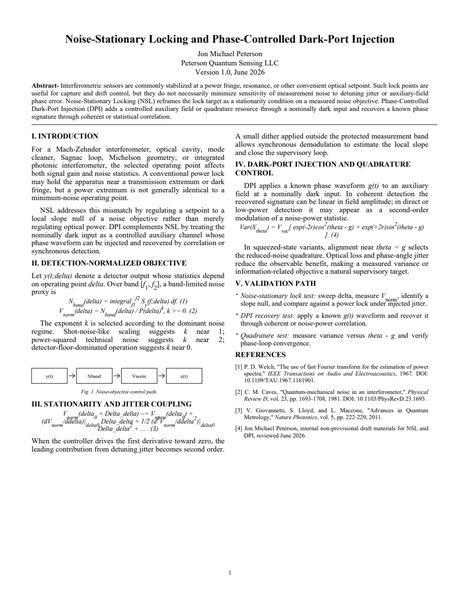
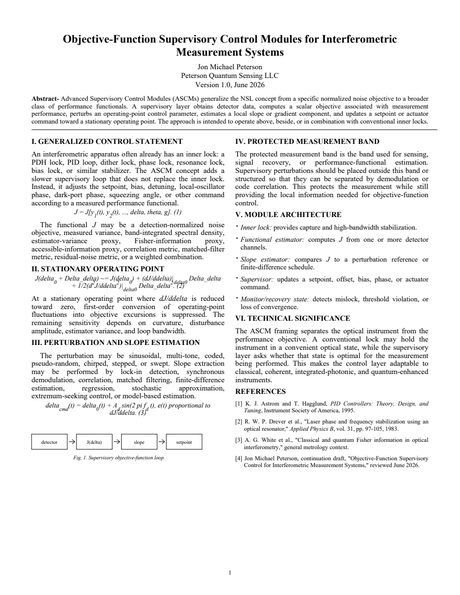
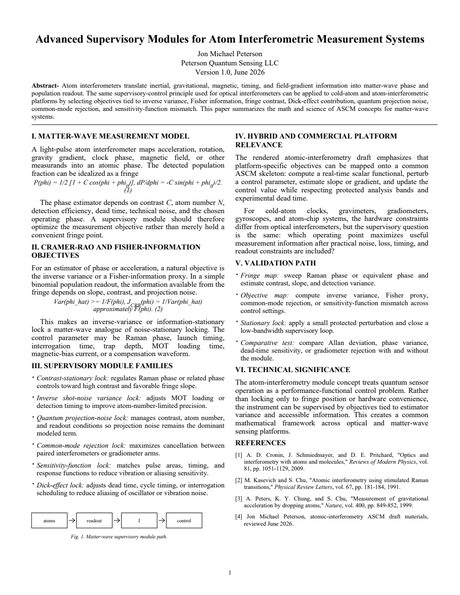
Precision becomes valuable when it helps someone make a decision. A stable instrument is a starting point, but holding a setting steady does not always preserve measurement quality. Peterson Quantum Sensing is developing a supervisory software or firmware layer that pays attention to a defined noise or information objective alongside an instrument's existing controls.
The idea is to make small adjustments, observe their effect, and seek favorable measurement conditions. A quieter output still has to preserve the desired signal. Calibration, bias, and response speed matter.
Today, PQS is at the electrical proof-of-principle stage. In one experiment with a deliberately moving optimum, active control reduced the median test objective by 3.68 decibels, about 57 percent, compared with a fixed setting after a documented tuning change. These numbers describe the same electrical objective comparison. They do not establish an improvement in optical sensitivity or customer throughput.
The test used a physical electrical signal path with software-defined actuation and measurement, one programmed disturbance pattern, and separate passes in a fixed order. The next step is stronger repeated electrical testing, followed by optical validation against an independently calibrated measurement.
The proposed applications include precision metrology, industrial optical inspection, and scientific interferometry. Existing stabilization, detection, and isolation tools already solve important problems. PQS's opportunity is to demonstrate additional value where a controllable quality limitation remains.
For a prospective collaborator, the starting point is a focused evaluation: a clear measurement problem, an accessible adjustment, and a reference that can establish whether the final result improves. Learn more at p q sensing dot com.