
Lower median test objective
Active control versus a fixed setting after a documented tuning change.
A stable instrument is the starting point. Peterson Quantum Sensing is developing control technology that also pays attention to the quality of the measurement.
Follow the light and control signals through PQS’s proposed compact system. This educational animation explains the mechanisms; it does not show measured optical performance.
This is a proposed compact optical bench for Peterson Quantum Sensing. Two Mach Zehnder interferometers share a middle beam splitter. Follow the light first, then the electronics. The animation explains phase control, noise stationary locking, and coded probe recovery. It illustrates mechanisms, rather than measured performance.
The first beam splitter sends coherent light into two arms. Each folding mirror redirects its arm toward the shared corner. The colors identify routes, not different wavelengths. The moving markers show direction. Real light travels straight between components, and much faster than this illustration.
The electro optic modulator sits between beam splitter one and mirror one. Its electric field changes the crystal refractive index, shifting optical phase. The crystal does not slide like a piston. A known electrical waveform supplies the phase code. Interference downstream converts that phase change into a measurable intensity response.
At the shared beam splitter, each incoming arm contributes to both outgoing arms. Their fields add with phase sensitive interference. As the first stage phase changes, power moves between these two paths. Both paths feed the second stage. The old intermediate detector is therefore removed.
The second pair of arms acquires another relative phase before the final beam splitter. The two photodetectors convert output intensity into electrical current. In this ideal lossless model, their powers are complementary. Their sum tracks total power, while their difference contains phase dependent information.
A calibrated fast lock compares the readout with its target and drives a piezoelectric mirror actuator. A small mirror displacement changes optical path length. Negative feedback opposes phase drift within the loop bandwidth. The illustrated actuator motion is exaggerated. Residual noise remains, even after the phase is held near its target.
Small, distinct actuator tags can share the same detector signal. Synchronous demodulation compares that signal with each reference to separate the responses. The two stages are coupled, so calibration must show that both controls remain distinguishable at the chosen bias. More detector channels alone do not guarantee independent phase information.
Noise stationary locking examines a defined noise band and normalizes the measured noise by an appropriate power factor. Known probe and dither contributions must be excluded or accounted for. This example uses a synthetic technical noise objective. A lower score is useful only while the instrument retains enough power and sensing response.
The supervisor makes a small setpoint nudge and checks whether the noise score rises or falls. Repeated measurements estimate its slope. Near an interior minimum, opposite nudges balance. Zero slope alone is insufficient: a maximum also has zero slope. Curvature and operating constraints determine whether the point is useful.
The supervisor slowly adjusts the fast lock setpoint toward a useful noise optimum. The inner loop keeps the optical phase near that moving target. It does not eliminate every disturbance or create squeezing. The illustrated improvement comes from the assumed technical noise landscape and must be tested on a real bench.
The known modulator waveform also provides a reference for correlation. The processor compares the detector response with that reference, allowing a coded probe component to be estimated alongside control signals. This layout uses internal arm modulation. Independent dark port field injection would require a separate coupling point.
The complete concept combines fast phase stabilization, slow supervision of a noise statistic, and a known probe for readout. The shared beam splitter reduces optics, while shared acquisition reduces duplicated electronics. The essential experimental question is whether this combination improves a useful measurement while preserving stable control and sensing sensitivity.
In a controlled experiment with a deliberately moving optimum, PQS feedback lowered a defined test objective relative to a fixed setting.
Active control versus a fixed setting after a documented tuning change.
A second way of expressing the 3.68 dB result, not a separate benefit.
64 of 71 one-second intervals tracked the optimum reconstructed afterward.
One programmed disturbance pattern; separate passes in fixed order; a physical electrical signal path with software-defined actuation and measurement. These are electrical test metrics, not demonstrated optical sensitivity, accuracy, or customer throughput gains.
Read the result, its limits, and what comes next →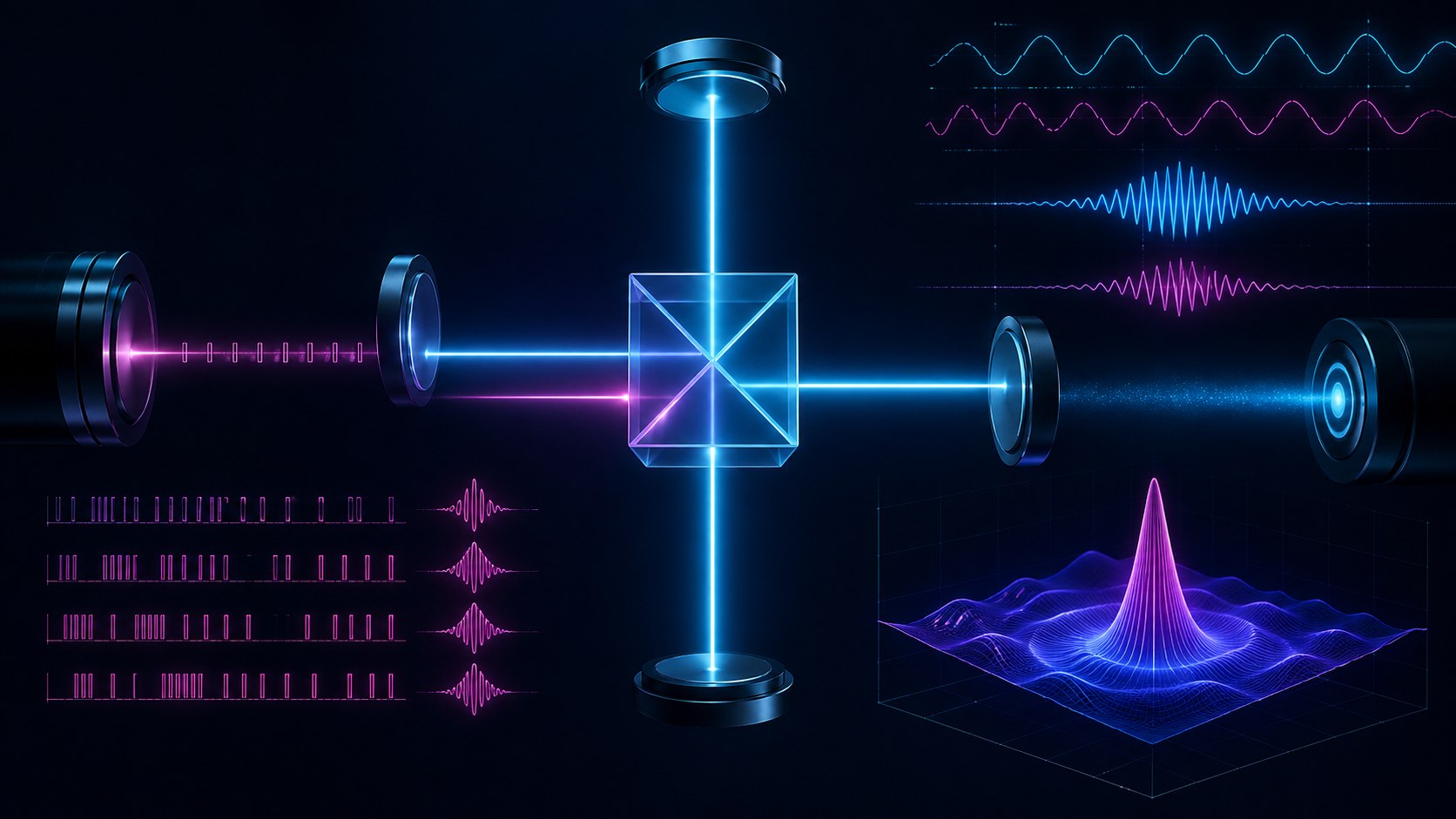
A primary controller can hold a setting steady while measurement quality changes. PQS investigates a slower supervisory layer that looks for favorable conditions alongside that existing control.
Evaluate a defined noise or information statistic, accounting for changes in measurement strength.
Use completed measurements to decide how to change an accessible control.
Check the desired signal, calibration, bias, and response time against an independent reference.
The opportunity is specific: an instrument with a controllable quality limitation and a clear way to prove improvement.
Investigate whether supervisory feedback can preserve useful precision in measurements of displacement or optical path changes.
Define a meaningful benchmark →Explore whether optical coherence tomography can retain measurement quality as operating conditions change, without sacrificing resolution or speed.
See the application →Test noise objectives alongside calibrated signals in experiments where measurement conditions can be adjusted and independently checked.
Explore research fit →Explore how a chosen noise objective can reach its minimum away from maximum power. This educational model illustrates a concept; it is not PQS test data.
Change the relationship between power and noise, then compare the selected operating points.
Objective J = Nband / Pk. A power floor prevents a low-output operating point from being selected. The appropriate normalization must be justified for a real instrument.
Curves scaled separately to their own maxima for comparison. The objective is drawn only where the power floor permits operation.
Drop a CSV here or choose a file. Data stays in your browser. Columns: delta,P,N_band; phase in degrees. Up to 2 MB and 5,000 rows.
The illustrative curves are P = 0.55 + 0.45 cos(δ) and N = 0.08 + A[1 − cos(δ − offset)]/2. The displayed choice is the lowest sampled objective that meets the power floor. It can land on a boundary; a sampled minimum is not proof of a stationary point or a working controller.
A smaller noise objective does not, by itself, establish lower measurement uncertainty. Signal response, bias, bandwidth, and calibration still matter. Uploaded CSVs are explored as supplied and are not certified PQS results. Shared links include model settings only, never uploaded measurements.
A simple correlation experiment illustrates one ingredient of a coded auxiliary-channel concept.
A random ±1 code is shifted and mixed with simulated Gaussian noise. Correlation searches for that shift. Recovery can fail as noise increases.
Received waveform · arbitrary amplitude
Circular correlation · trial shift in samples
Peak/off-peak RMS is a descriptive statistic for this realization, not a calibrated processing gain or a PQS performance claim. This simulation does not model an optical dark port, squeezed light, or quantum advantage.
Stabilization, lock-in detection, balanced receivers, and isolation already solve important problems. PQS’s proposed role is to evaluate an additional measurement-quality objective alongside those tools.
Your fast controller maintains the quantity it was designed to stabilize. PQS proposes a separate supervisory task.
Software or firmware is the intended commercial form. Compatibility, overhead, and integration effort still need to be established.
An application benchmark must show that a lower internal objective delivers a useful measurement benefit.
Follow light through an interferometer, explore atomic sensing, listen to the current overview, or read the technical concepts behind the program.
Have an instrument with a measurable limitation and an accessible control? Let’s define a focused evaluation.