
Flagship: Noise-Stationary Locking
Quantum-grade measurement stability for interferometric optical sensors — the first and most developed module, detailed throughout this site.
Advanced Supervisory Modules · measurement-aware interferometryPatent pending
In plain terms: we build firmware that keeps precision laser instruments parked at their most accurate, lowest-noise setting — automatically. Like autofocus, but for measurement noise.
Conventional locks keep an instrument optically stable. PQSensing builds Advanced Supervisory Modules — a firmware performance layer that asks a harder question: is the instrument parked where it produces the most usable measurement information? Our flagship module, Noise-Stationary Locking, brings this to quantum-grade optical sensing; the family extends across inertial, timing, and quantum-communications instruments.
Watch · 80 seconds
Precision instruments lock onto the brightest signal — but the brightest point isn’t always the most accurate one. This short explainer shows, in plain terms, how NSL parks an instrument where its measurement is quietest instead, and why that matters for everything from navigation to quantum sensing.
Prefer to listen? 2-minute spoken overview →
The platform
Across precision instruments — interferometric optical sensors, inertial and fiber-optic gyros, frequency references and optical clocks, quantum links — the limiting factor is rarely whether the device is locked. It is whether it is held at the operating point where its numbers are actually best. PQSensing packages that discipline as a family of Advanced Supervisory Modules: a firmware layer that runs alongside your existing lock and keeps the instrument parked where the measurement is cleanest.
Quantum-grade measurement stability for interferometric optical sensors — the first and most developed module, detailed throughout this site.
Further modules target inertial sensing, optical clocks and frequency references, and quantum communications — each tuned to the figure of merit that matters for that instrument class.
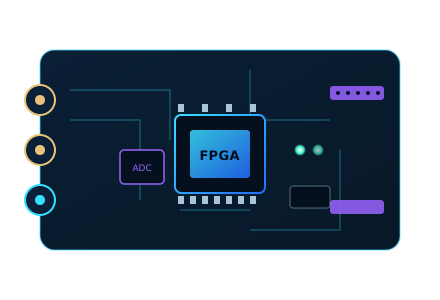
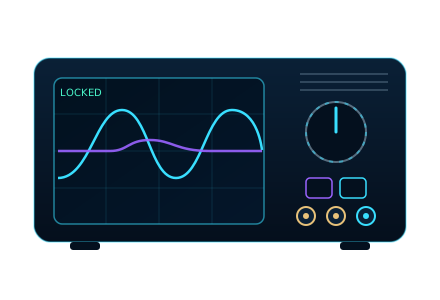
Delivered as firmware for standard FPGA-based lab instruments, including Liquid Instruments Moku and Red Pitaya — deployed alongside the locks already on the box.
Seeking collaboration
PQSensing is looking for a university lab, metrology partner, instrument company, or technical sponsor to help test Noise-Stationary Locking on a classical tabletop interferometer.
The first experiment is deliberately modest: compare a conventional PDH, power, or PID-style lock against a normalized noise-objective lock under controlled vibration, thermal drift, and phase/path-length disturbance.
What we need: access to an optical bench or Mach-Zehnder/cavity test setup, photodetector readout, a PZT or phase actuator, DAQ/controller support, and technical guidance on a defensible validation protocol.
What partners get: a focused applied optics/control project, possible student-useful data, early visibility into Kansas-origin photonics IP, and a clear sponsored-research or prototype path if the traces are interesting.
The buyer pain
That is the use case. The lock is holding the optics, but vibration, thermal drift, laser-frequency noise, platform motion, speckle, detuning jitter, or quadrature-angle error still corrupt the measurement band.
The customer does not buy a pretty fringe — they buy a smaller error bar. NSL + DPI is for instruments that are optically locked but not measurement-optimized: the lock says stable, the noise floor says otherwise.
Integration time should shrink the error bar. When the operating point drifts or the noise becomes nonstationary, longer averaging can collect drift instead of information.
Squeezed-light benefit depends on alignment, loss, and phase stability. A squeezed source is not enough if the readout drifts away from the low-variance quadrature.
A nominally dark port can be more than an empty input. DPI turns it into a controlled channel for calibration, coding, ranging, interference rejection, and squeezed-light injection.
What we are doing
NSL + DPI is intended to augment established optical locking methods such as PDH, not pick a needless fight with them. PDH keeps the cavity or interferometer captured. NSL trims the operating point toward the quietest useful measurement condition. DPI gives the dark port a controlled job.
Use PDH, bias locking, or another conventional method to maintain optical capture and keep the instrument in range.
Compute normalized measurement-band noise and servo the system toward a point where small detuning errors no longer cause first-order noise degradation.
Inject a controlled auxiliary field, phase code, pilot signal, or squeezed vacuum through the dark mode and recover useful signatures at the output.
Interactive demonstration
A power lock parks at the fringe extremum. A noise-stationary lock parks where the slope ofVnorm(δ) = Nband(δ) / P(δ)kgoes to zero. Whenever real-world noise has structure that isn't perfectly aligned with the fringe — which it rarely does — those two operating points are not the same. Drag the controls, share a regime, or drop in a measured bench trace.
Pedagogical model, not bench data. Analytic curves illustrate the slope-null thesis. The validation sprint replaces these with measured curves from a tabletop Mach–Zehnder — or drop a trace above to preview the comparison on real data now.
Why optimize variance?
For a photon-limited phase measurement, the useful relationship is:
Lower and more stable Vnorm means the same photon flux and integration time produce a smaller phase-error variance. That can mean better precision in the same time, the same precision faster, or the same result with less optical power.
How we intend to do it
Read the detector stream y(t) from a photodiode, balanced detector, homodyne receiver, or related interferometric readout.
Estimate band-limited noise Nband, compute an optical power metric P, and form the normalized objective.
Apply a small operating-point dither to δ outside the protected measurement band to probe the objective’s slope.
Synchronously demodulate Vnorm against the dither reference to estimate dVnorm/dδ.
Drive the actuator toward dVnorm/dδ ≈ 0 while preserving a power floor and using mislock recovery logic.
Hold the quietest useful operating point so photon integration continues to reduce the measurement error bar.
Phase-Controlled Dark-Mode Injection
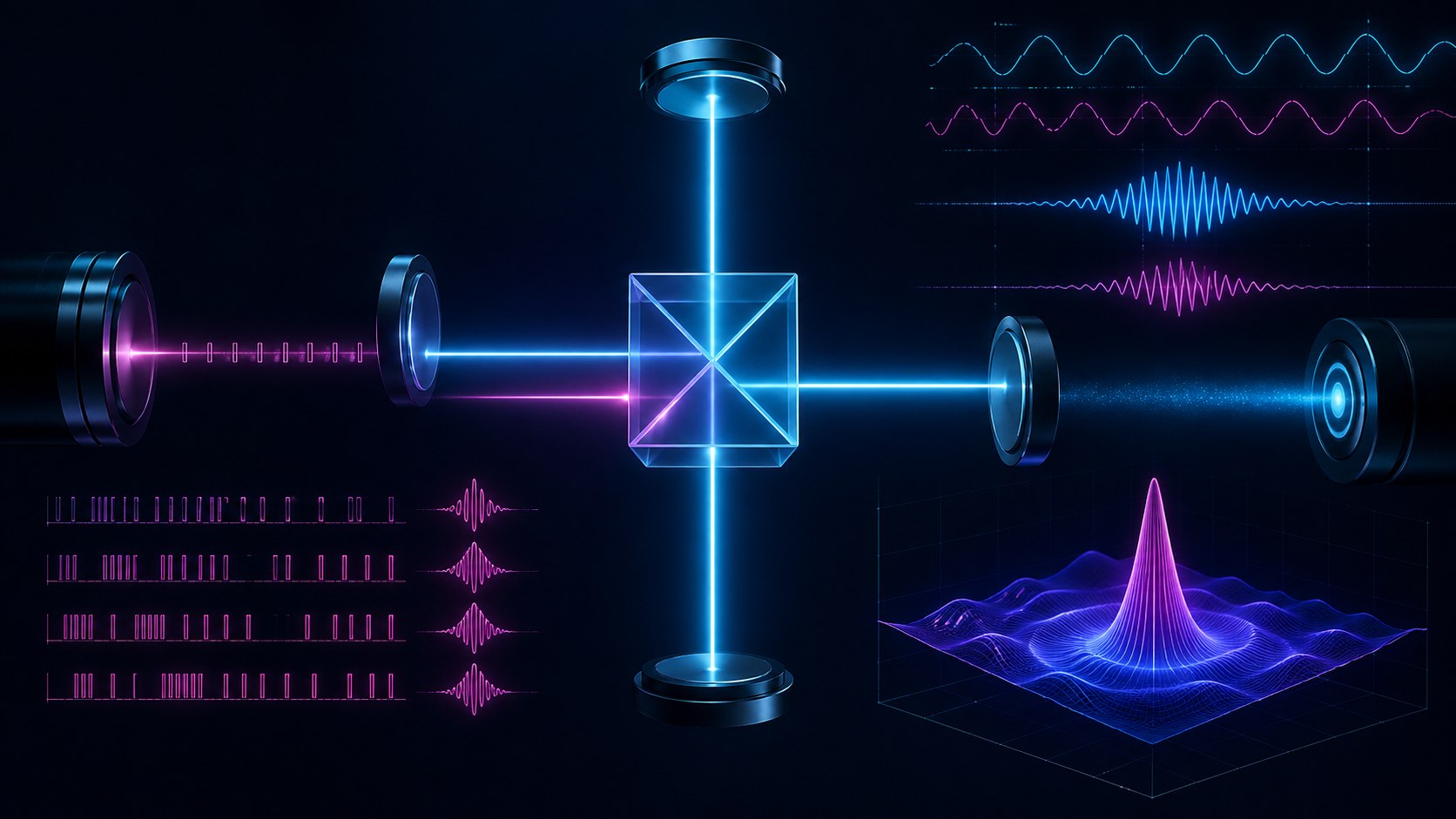
In a conventional interferometer, the dark input is often treated as unused or as a passive vacuum input. DPI uses that port intentionally. A known phase waveform g(t), pilot signal, code, chirp, coherent auxiliary field, or squeezed vacuum can be injected and recovered through synchronous detection, correlation, matched filtering, or homodyne readout.
Interactive demonstration · dark-port injection
Inject a known phase code g(t) through the dark port, bury it under channel noise, then correlate the received stream against the code you sent. The matched filter concentrates the code's energy into a single peak while noise stays spread out — the processing gain that makes weak coded signatures recoverable.
Pedagogical DSP model. A binary phase code is injected at a random lag, buried under Gaussian channel noise, and recovered by cross-correlation. The peak height over the noise floor is the processing gain that dark-port coding buys you.
What can this help measure?
If the physical quantity can be converted into an optical phase, path-length, quadrature, or time-delay change, NSL + DPI may help move it from “buried in noise” to “recoverable with usable integration time.”
Mirror motion, MEMS motion, wafer-stage position, precision machine vibration, optomechanical displacement.
Fiber strain, structural deformation, composite stress, shape sensing, pressure-vessel or pipeline strain.
Proof-mass motion, cantilever force, membrane pressure, acoustic diaphragm motion, hydrophone-style sensing.
Sagnac-style rotation, fiber gyro readout, GPS-denied navigation support, platform stabilization.
Trace gas, fluid contamination, biosensing, lab-on-chip refractive-index shifts, molecular binding effects.
Sub-shot-noise phase shifts, squeezed-light readout, low-variance quadrature tracking, dark-port quantum resources.
Dark-port code recovery, matched-filter timing, correlation peaks, multiplexed instrument identification.
Not magic. Not “measure anything.” The claim is sharper: preserve the measurement condition so small interferometric signals can be recovered sooner and with less noise-floor wandering.
Validation plan
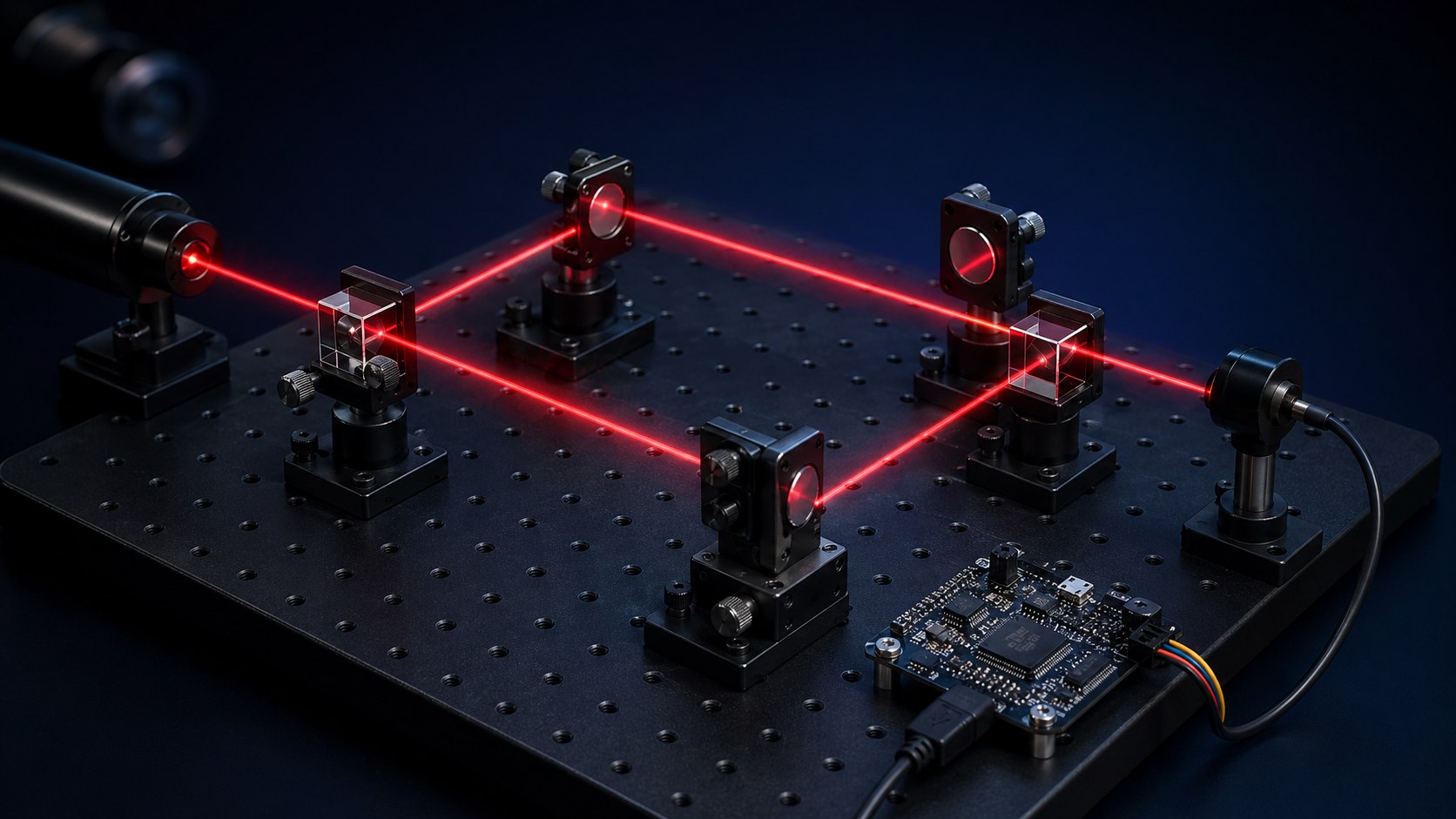
The first milestone is intentionally lean. No squeezed-light source is required to validate the core control principle. Build a classical MZI, sweep the operating point, map power and Vnorm, inject controlled detuning jitter, and compare a conventional power lock against NSL.
Prototype metrics
These are validation targets, not guaranteed product specifications. The point is to produce defensible traces that prove or kill the control thesis.
Market wedge
Metrology OEMs: cavities, mode cleaners, MZI/Michelson platforms, displacement and precision phase sensors.
Defense and navigation: inertial sensing, gyro readout, platform vibration, GPS-denied measurement support.
Photonics and integrated sensing: MZI/PIC control firmware, dark-port coding, correlation signatures, interference rejection.
Quantum-sensing labs and partners: squeezed-light injection, quadrature alignment, homodyne readout, practical quantum advantage.
Where things stand
A ten-second read for lab partners and investors — the concrete signals behind the thesis, each one linking to the detail.
Non-provisional patent filed for Noise-Stationary Locking & Dark-Port Injection.
Patent pendingThree non-confidential white papers, each with a ready-to-paste BibTeX citation.
Read the papers →Live, interactive NSL and dark-port demonstrations — running math, not slideware.
See the demo →Bench-data format standardized (PQS-Trace v1.0); actively seeking a lab partner for the tabletop sprint.
Partner on it →Ways to work together
Whether you run a lab, write checks, need drawings, or just think this is interesting — here’s the door.
University or metrology lab? Help run the tabletop Mach–Zehnder sprint comparing a conventional lock against NSL. Classical optics, no squeezed source required.
Discuss a validation sprintRead the lab one-pager (PDF) ↓Patent-pending deep-tech IP with a lean, defined first milestone. A $10K classical-MZI data sprint that proves or kills the thesis.
See the ask & deckNeed construction documents, HABS historic documentation, or photoreal renders? The founder’s Media + Architecture practice takes on residential, commercial, and historic work.
Explore Media + ArchitectureWorking on interferometry, control, DSP, or quantum sensing — or just curious? Reach out to trade ideas or find a way to build together.
Say helloDevelopment updates
Adopted the official Peterson Quantum Sensing logo, letterhead, and typography site-wide, gave the Media + Architecture practice its own identity, and embedded an in-page player for the founder's EverSound Records catalog.
pqsensing.com migrated to a static Astro build: live Noise-Stationary Locking demo with shareable-state URLs and a CSV bench-trace loader, a new dark-port matched-filter demo, typeset math, and a publications index.
Targeted the Kansas State prototype at the Liquid Instruments Moku FPGA platform, so a first reproducible bench validation of NSL runs on standard, widely available lab hardware.
Immediate ask
The first funding unit is not a full quantum hardware build. It is a lean classical MZI validation package: optical bench or partner lab access, detector/readout path, actuator, DSP, jitter injection, and reproducible data comparing conventional locking against NSL.
Optics + mechanics: breadboard, mirrors, beamsplitters, mounts, alignment hardware.
Readout + control: photodiode or balanced detector path, DAQ/interface, PZT/phase actuator, driver.
DSP + analysis: real-time Vnorm pipeline, dither/demod loop, reproducible notebooks.
Output: raw logs, plots, updated deck, technical package for companies, SBIR/STTR, investors, and lab partners.